Showing posts with label epidermis. Show all posts

Wednesday, January 23

Epidermis - Definition of epidermis

Home > Know your skin > Epidermis definition
The epidermis is the outermost of the two layers of skin. Epidermis is composed of five well defined layers, namely strata corneum, lucidum, granulosum, spinosum and germinativum.
In structure it is made up of keratinocytes, melanocytes, Langerhans cells and Merkel cells.

The proliferating basal cells differentiate into keratinocytes for forming a natural barrier against the elements and pathogens and also protect the skin from loss of moisture.

Merkel cells present in it are mechanoreceptors and make the skin sensitive to touch. Langerhans cells have immune function and help in eliminating pathogens.
Human skin color complexion is due to the melanin pigment produced by the melanocytes.

Definition of epidermis

As per Wordnetweb.princeton.edu/perl/webwn the definition is:
"the outer layer of the skin covering the exterior body surface of vertebrates."

Thefreedictionary.com's definition is:
"the outer, protective, nonvascular layer of the skin of vertebrates, covering the dermis."

According to Macmillan Dictionary it is:
"the outer layer of skin on top of the dermis. Hair and feathers grow from the epidermis."

According to Merriam-Webster it is:
"the outer epithelial layer of the external integument of the animal body that is derived from the embryonic epiblast; specifically : the outer nonsensitive and nonvascular layer of the skin of a vertebrate that overlies the dermis."

The definition by Oxford Dictionaries is;
"the surface epithelium of the skin of an animal, overlying the dermis."
Reference:
1.Harding, C. R. (2004), The st. corneum: structure and function in health and disease. Dermatologic Therapy, 17: 6–15. doi: 10.1111/j.1396-0296.2004.04S1001.x
Image source:
http://en.wikipedia.org/wiki/File:Skinlayers.png
Author: Serephine
License: Public domain

Current topic: Definition of epidermis.

Get glowing skin complexion. Remove acne scars and blemishes from face.

Monday, January 21

Epidermis parts - Five layers of epidermal skin in order

Home > Know your skin > Epidermis > Descending order of five layers of epidermis
Epidermis is the outermost of the two layers of skin. Epidermal skin is made up of five parts (sublayers).
Its structure is made up of keratinocytes, melanocytes, Langerhans cells and Merkel cells and the majority of them (about 90%) being keratinocytes.

Five layers of epidermis in descending order

Starting from outermost region it is divided into the following five parts or strata in the following order:
  1. Stratum corneum
  2. Stratum lucidum
  3. Stratum granulosum
  4. Stratum spinosum
  5. Stratum basale (also called "stratum germinativum")
Epidermis is avascular (having no blood vessels) and is nourished  by the dermis by diffusion. There is continuous mitotic cell division process going on in keratinocytes in the deepest part of this layer. Each keratinocyte divides into two identical daughter cells of which one remains to carry on the next mitotic cell division and the other one migrates upwards. The older cells are pushed upward and in this process move away from the nourishing dermis. With the loss of nourishment they die and get flattened to form many layers of dead cells, eventually getting sloughed off.

The melanocytes are present in the deepest part and they produce and transfer the skin pigment to the surrounding keratinocytes. Langerhans cells detect the intruding foreign bodies and transport them to lymphocytes present in dermis. Merkel cells present at the deepest part of epidermis function as mechanoreceptors.
Reference:
1.Harding, C. R. (2004), The st. corneum: structure and function in health and disease. Dermatologic Therapy, 17: 6–15. doi: 10.1111/j.1396-0296.2004.04S1001.x
Image source:
http://en.wikipedia.org/wiki/File:Skinlayers.png
Author: Serephine
License: Public domain

Current topic: Parts of epidermis - five layers in descending order.

Get glowing skin complexion. Remove acne scars and blemishes from face.

Saturday, August 14

Skin care - Skin physiology - Function of epidermis

Physiology of skin - Function of epidermis → function of dermis

Human skin has two important and main layers, dermis and epidermis with different physiology and function.

Epidermis, the outermost layer of skin, functions as a chemical and physical barrier between the interior of the body and external environment.
Its physiology and function include secretion, excretion, insulation, protection and pigmentation. Dermis is the deeper layer and its main action is to provide structural support to the skin.

Skin physiology: function of epidermis in protection

The main action of bottom most layer of epidermis, which lies adjacent to dermis, is the cell multiplication.
The new cells progressively move towards the outer layers, simultaneously maturing and differentiating.

The physiology and shape of the cells also changes and by the time they reach the top most layer, they are flattened, lacking nuclei they become lifeless.
At this stage they are called corneocytes and are filled with keratin proteins capable of water retention and also lipids.
The outer most layer, which contains 10-30 layers of stacked corneocytes, is called Stratum Corneum and is semi-permeable, becoming a barrier between the interior of the skin and external surroundings.
Epidermis physiology also includes functions as physical barrier protecting the internal tissues from bacterial invasion, physical abrasion and ultraviolet rays.

Skin physiology: function of epidermis in thermoregulation, excretion and sensation

In hot weather, skin physiology is tuned to produce sweat.
Sweat on reaching the epidermis surface, evaporates cooling the surface by the latent heat of evaporation.
In response to low temperatures, sweat is decreased and blood flow to the skin is increased to maintain the temperature.
Besides removing excess water and temperature control, the sweating process also removes smaller quantities of waste salts and many organic compounds.
The nerve fibers (Merkel cells) reach upto the outer most layer of dermis and stratum basale and pick up sense signals of touch, temperature, pain and pressure.

Skin physiology: function of epidermis in immunity

Certain specialized cells of epidermis, Langerhans cells, have immune functions.
Though these cells originate from bone marrow, they migrate to epidermis layers.
These dendritic cells have Birbeck granules.
They interact with white blood cells (helper T cells) and help in destroying the invading organisms.
Apart from detection of foreign bodies, Langerhans' cells, have a major role in the physiology of allergies.

Skin physiology: function of epidermis in skin coloration

The black-brown melanin pigment, is produced by the melanocytes present in basal layer of epidermis.
Melanocytes comprise up to 10% of the cells in epidermis.
skin layers
skin layers
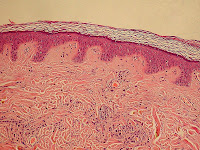
Epidermis and dermis

The slender projections of melanocytes extend to keratinocytes and help in the transfer of melanin granules.
Melanin granules apart from imparting color to skin also protect it from UV rays.
Melanin granules clump on the surface side of keratinocytes, protecting the nucleus from UV light and genetic damage.
The scattering and absorbing of Uv rays by melanin protects the internal cells by blocking free radical formation and damage.

Thus with multiple functions, epidermis plays a major role in skin physiology.

Get glowing skin complexion. Remove acne scars and blemishes from face.